Depreciated Value Statement
The are two main factors in determining the depreciated value of equipment. The first is the information in the equipment file, such as original cost,
built date, re-built date, car type and other information. If the car has any additions and/or betterments, they must also be entered in the system.
When entering or editing equipment, "File, Equipmnet, Betterments", you enter either the current car or original car number. If there is already information on additons and betterments, than that information will appear. The screen will inform you how many additions and betterments exist with the car and display all the information pertaining to the first entry along with other information. The classification, also known as the DDCT Type Code,
of the Addition and Betterment will appear on the right side in the second section. This classification is very important as this determine the depreciation percent as well as the maximum percent for the depreciation. It also determines if the depreciation is based on years or months. As you select a Classification, the system will inform you at the bottom of the screen exactly what that classification is.
Entering Additions and Betterments to Equipment
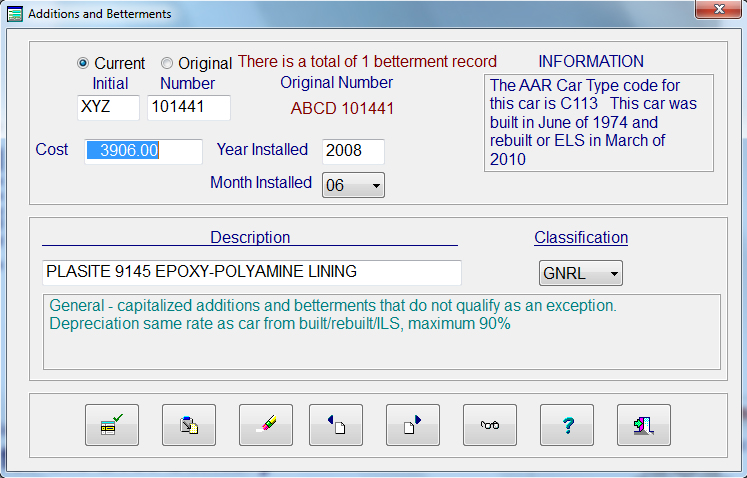
Classifications available are as follows;
GNRL - General - capitalized additions and betterments that do not qualify as an exception. Rate is the same as the car from date car was originally built, re-built or certified for ELS with a Maximum of 90%
INIT - Capitalized - Initial load of historical A and B amounts as of UMLER 4.6 implementation date. Same rate as for car to which applied, from date car was originally built, re-built, or certified for ELS with a Maximum of 90%
COIL - Outside heater coils applied to tank shell by fusion welding. Includes renewal of damaged car. Same rate as for car to which applied, from date car was orignally built or re-built with a Maximum of 100%
CONT - Containers (metal, rubber, or combination metal/rubber). 7% per annum from date car was originally built or rebuilt with Maximum of 90%
FLLD - Other permanently installed loading equipment used on flat cars. 8% per annum from date of original application with Maximum of 90%
IHTR - In-transit heater applied to car. Includes renewal in damaged car. When installed coincidental with construction of car, the amount charged to Capital Account for such installation may be estimated. 6% per annum from date of original installation with Maximum of 90%
JTHR - Jacketed thermal shield with integral headshield. Same rate as the car, from date of original installation with Maximum of 90%
LOLI - Protective coating inside LO covered hopper, includes renewal of lining in damaged cars. 2% per month from date of application with Masimum of 100%
NTHR - Non-jackted thermal protection system. Includes renewal in damaged cars. 5% per annum from date of application with Maximum of 100%
RACK - Multi-deck racks used on flat cars for automobiles. 5% per annum from date originally built or re-built when multi-level rack and car are of divided ownership or reported in UMLER as car and multi-deck racks, separately. When car with permanently installed multi-level rack is reported to UMLER as a single integrated unit, rate of depreciation for the entire unit will be at the same rate for the car in which installed. Maximum rate of 90%
REFR - Mechanical refrigerating systems or thermostatically controlled temperature device (including power equipment). When installed coincidental with construction or Rule 88 rebuild, the amount charged to Capital Account for such installation may be estimated. 6% per annum from date of original installation or rebuild of the car with Maximum of 90%
RUBB - Rubber, polyvinyl chloride and polyurethane elastomeric linings applied to inside of tank. Includes renewal in damaged car. 5% per annum from date of application with Maximum of 100%
SPAR - Any type Sparger system applied. Includes renewal of lining in damaged cars. Same rate as for car in which installed, from date car was originally built or re-built with Maximum of 90%
STNS - Stainless steel inner shell, heater coils of other than ordinary steel pipe. Same rate as for car, from date of original installation with Masimum of 90%
TKLI - Protective coating to inside of tank. Includes renewal of lining in damaged car. 2% per month from date of application with Maximum of 100%
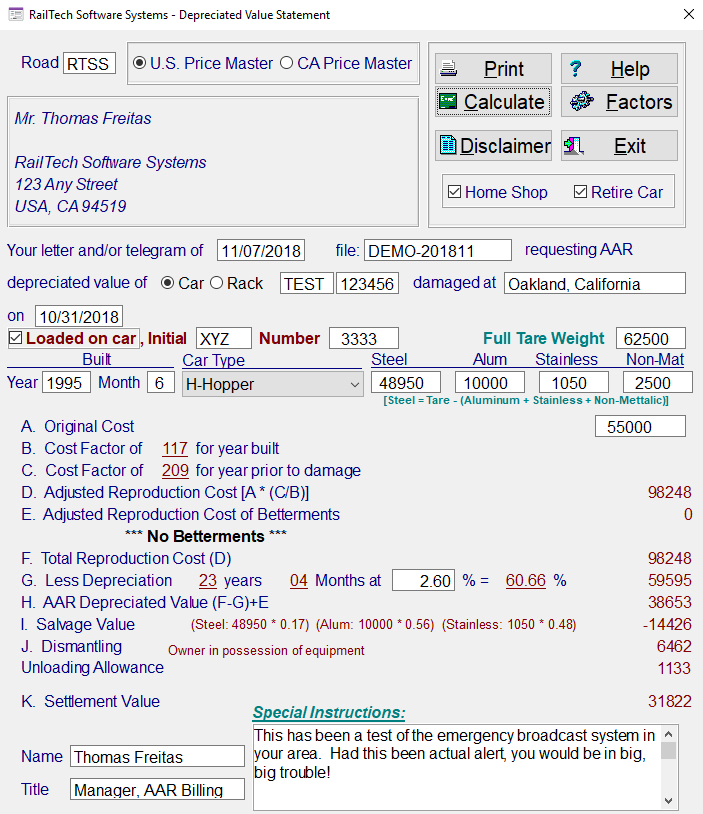
The depreciated value statement screen is automatic in most areas. Once you put in the initials of the company that has requested the DV, the system will look at your rolodex file for those initials, and if found, will show the name and address of the company. When you enter the car initials and number, the system will validate the car.
If the car is valid, the system will then populate the built date, rebuilt date, original cost, and calculate the cost factors. All you need to do now is to press the push button that is marked Calculate and your depreciated value statement is ready for printing.
If the system does not find the car in your file, than you may enter the values manually and caluclate the depreciated value by clicking on the Calculate push button.
When entering weights, such as Aluminum, Steel, Stainless Steel and Non-Mettalic weights, the system will automatically calculate what the tare weight should be based on those entries.